


Classic research process.
A standard marketing research process has already been developed, which I will not comment on in detail. You can read about it anywhere. It is purely formal. In short, it consists of five consecutive stages.
Stage 1. Problem definition
Stage 2. Research project development
Stage 3. Fieldwork or data collection
Stage 4. Data preparation and analysis
Stage 5. Report preparation and presentation
The main stages of this process are the first and second. We have just gone through them. The fourth and fifth stages are almost integrated into the "Planning" part. Data preparation will still take place here, but their analysis and report preparation will be in the "Planning" part. So here we will focus on the third stage and will analyze the data collection process.
Research in the style of "Well of Knowledge".
I suggest organizing the information gathering process according to the well-known three-step process.
(I) - First, find free information. (II) - Then you can purchase information that has been previously collected and analyzed by experienced people. (III) - And only then, when the range of questions is significantly narrowed, you can directly address your objects of interest.
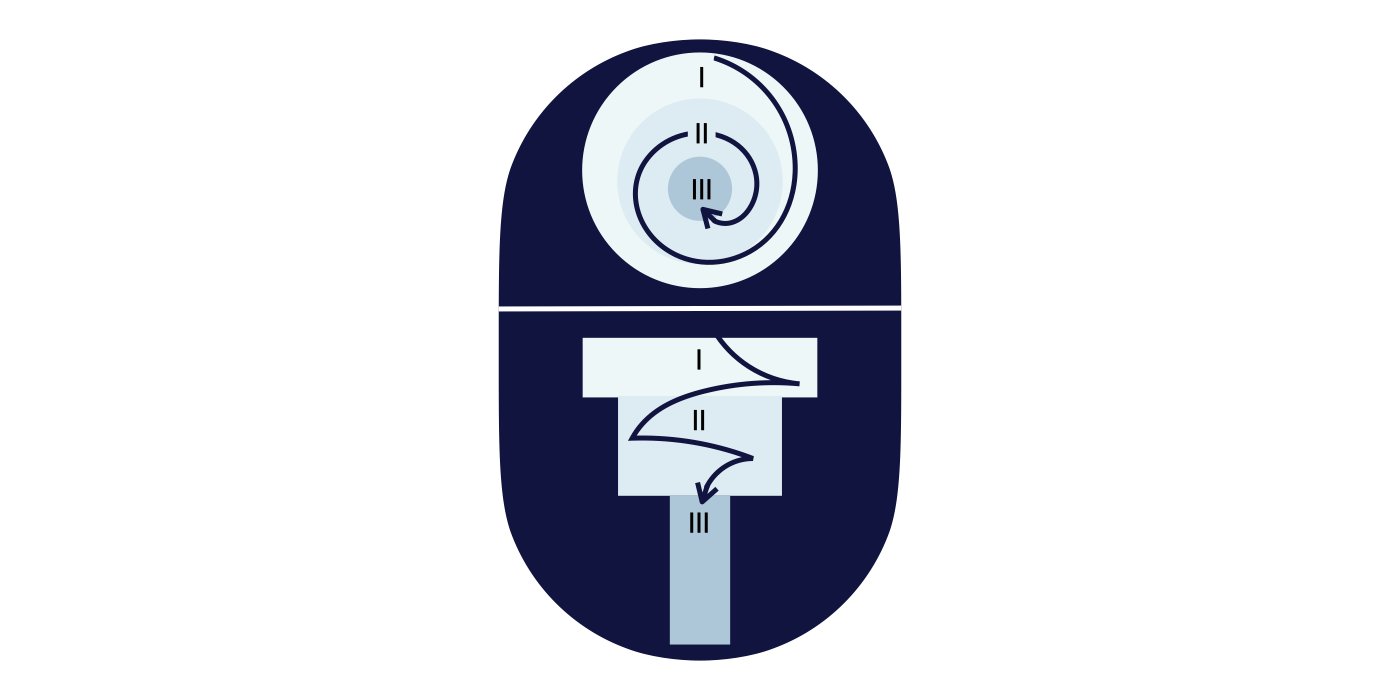
"Well of Knowledge"
These steps should look like three concentric circles that bring you closer to the center, where what interests you is located. Later, you may need to go through this procedure several times. For various reasons. We will analyze it more specifically in the relevant sections. It is unlikely that you will choose exactly those consumers who will lead you to success the first time, but sometimes this happens. Steve Jobs initially hoped to capture corporate clients, but it turned out that he captured professionals. So just be prepared for this. What will the research in the form of three concentric circles give you? It will allow you to gradually get closer to your goal, without spending a lot of time and money. Change the direction of the search if you get negative results. At the beginning of your research, you do not need to immediately dive deep. Metaphorically speaking, you will first see the picture from above, then approach the surface to take a closer look at what interests you, and only then go down so low that you can communicate with those you have chosen. This is a kind of hot air balloon flight that you should have seen in my drawing.
By A-B-C
In the book, I followed the A-B-C path. This is the most common option among those who are just starting a business. Remember, I told you about three options for determining what you are going to do. First, you determine what you would like to do (industry), then you find potential customers whose needs you plan to satisfy, and then you learn about those who will hinder you - competitors.
〈A〉An industry is a small world of your field of activity.
Industries may seem like something very big and significant to you. I'm not trying too hard and suggesting it to you. Not at all. I'm referring here to the small world of your field of activity. Wikipedia will not let us make a mistake. Industry (Ukrainian) means a field of activity, a section, or a set of similar activities. This can be a certain area of production, trade, service, etc. In economics, "industry" can mean: a set of enterprises and organizations that carry out similar production and economic activities. A direction or field of activity. Synonyms for the word "industry" can be: sphere, section, field, field, field, field. So far, you are most likely imagining not a specific product, but a conditional one. In order to get closer to reality, you need to immerse yourself in the industry that you have previously decided on.
〈B〉Consumers in the B2B market are always highly visible.
Unlike the B2C market, consumers in the B2B corporate market are almost always clearly visible. Company data is public, unlike personal data. This is good news. At first, you can limit yourself to thinking of the client as a legal entity. Only in sales will you understand that all your opportunities walk on two legs. But for now, consider that your clients are companies. Find them and research them. Look for them not only in the industry that you have defined for yourself. Look for them everywhere. For now, you are most likely imagining a conditional client. In order to get closer to reality, you need to get to know your clients better. Learn about them that they do not know about themselves. Record this data. To do this, I will offer you the necessary tools. Questionnaires, forms, etc. Of course, these will be samples that you adapt for yourself.
〈C〉B2B is always about competition
Not always do products for people in the B2C market compete fiercely. Mostly they try to find their consumer and influence him. Even Coca-Cola and Pepsi seem to appeal to different generations.
But in the corporate sales market, tender procedures and unfair competition are almost everywhere. Even if your product is unique and has no analogues, as some say, you will fight for corporate budgets with existing suppliers who have established relationships. I will say even more. If you still don’t have competitors, you will have to invent them to accelerate your sales. Therefore, B2B is always about competition.