

Why did I write the book?
We now live in an era of salvation. Humanity always lives in some era. This is how it calls time periods that are characterized by some common feature and have their heroes, known and unknown in our time. We can recall the Paleolithic, Neolithic, and some others. Once upon a time, humanity lived in the ancient era, in barbarian times, in the Middle Ages. In the Renaissance with its hero Leonardo da Vinci. It lived in the sailing era of the Great Discoveries, when humanity discovered new lands, the laws of the universe (physics), and the structure of the solar system. Columbus, Newton, and Galileo Galilei. Then came the modern era, when humanity tried to improve everything. This was the era of inventors of steamships, steam locomotives, oil production, cars, light bulbs, radio, and telephones. Most of everything that humanity uses was invented then. Now they are only improving it. It ended with wars in the 20th century. After that, the postmodern era of despair in the possibilities of humanity began. Its heroes are despairing. Apparently, these were hippies and those who do not believe in anything, even in God. Now, in my opinion, a great era of saving everything you want has begun. Saving both from real problems and from artificially invented ones. So the heroes of this new era are activists-saviors of the world. I always wanted to be a modern person and at least a little bit of a hero, so I decided that I also had to save someone.
The topics of ecology, sexual minorities, women's rights, and global warming are already taken up.
Hot topics of ecology, sexual minorities, women's rights, and even global warming are already taken up. It's too early to save humanity from artificial intelligence, and it's too late for me from fascism, because I'm an old man. Where I live, there aren't even rare animals. We only have constant economic troubles here. So I decided to save businesses from bankruptcy. To save their money from destruction. Precisely because I've been consulting on various business projects for many years, taught at business schools, worked in high positions, and had several businesses myself that were very successful. But most importantly, I've also had a couple of bankruptcies when I lost almost everything. Saving seemed like a very good idea to me. At first, I saved individual projects, but then I decided that life wouldn't even be enough to help entrepreneurs just from my street. Once I was walking around the city and saw various new businesses opening up — future drowning men. I approached someone from the first floor of the building where I live to warn him. But it was all in vain. People continued to burn money in front of my eyes with enthusiasm and pleasure. As if they were playing in a casino. But I immediately noticed those who had to try very hard not to succeed. They were so right in the right city, making such right market offers. It didn't look like gambling at all. I could see their future right from the names of new street establishments — without going into any of them. But I didn't speculate on it. Since I spent a lot of time in the B2B market, that's where I decided to do rescue work.
I want to be the savior of entrepreneurs, to save their money and dreams.
I decided to write a book to help as many entrepreneurs as possible save their money, and maybe their lifelong dreams. At first, I thought about social networks, but then I realized that in my business there is not much news that needs regular coverage. Many things have not changed for centuries and are still relevant. Also, infogypsies — lifesavers and sellers of success — have taken over everything there. I decided that a book would be better suited to my task. Due to the fact that most businesses fail when entering the market with new products, or into new territories, or even outside the country, that is why I called my first rescue book “Go-To-Market.xyz: Market Entry Navigator”. At first, I called it “Market Entry — Insights”, but then I realized that I would need help to reveal this important topic. Some borrowings, at least for the theoretical section. So the title of Insights is gone, but my insights themselves remain, and there are many of them. Maybe even too many for one book, but I don’t know if I’ll dare to write a second one. So enjoy my new perspective on strategy and market share, my explanations of positioning, my critique of SWOT analysis, and much more.
My background
I co-founded seven businesses and ran two as a hired deputy CEO. The first business was a brokerage firm on a major stock exchange. Speculation taught me a lot, fed me a little, but didn’t motivate me for the future — so my partner and I left the stock exchange. The second business was retail. A few stores. The third was a cafe-bar. The fourth business was a service center. The stores and cafes were successful, but they closed for non-profit reasons. The fourth service business was great, but very small. There was no way to scale it. I wanted to feel the scale. So my fifth business was a distribution business. I had partners. It grew in the 90s in two years from an initial investment of $100K to just under $100M in annual revenue when I was the commercial director. It wasn’t a growing market. It was divided between two competitors. The strategy worked. The company pushed both competitors off the pedestal, went national, and launched an expansion into foreign markets. But this outstanding experience did not prevent me from losing big in my next sixth business. In a technology startup. I even got a prominent client from the Fortune 500 list, who purchased my software product, but the project was forced to stop due to low sales. It was a startup with a very high-quality product that was ahead of its time by almost a decade. It was a painful marketing failure. Very subtle. We had all the elements of the marketing mix in perfect form. But it did not work due to the low capacity of the market at the stage of its birth. After ten years, the topic went up so much that some of those with whom we started at the same time ended up in the Fortune 500. It was very difficult to survive. So I told myself that I had something more important than the money invested, and now my product is a marketing experience. Yes, almost twenty years ago, a marketing company was born. My seventh business. During this time, I have directly participated as a consultant in more than a hundred projects. And I have been familiar with twice as many projects. I have taught at business schools and conducted seminars.
Uniqueness of the approach
How can I save your money? Write a book so that you can learn something new about business? There is already so much written about it that a lifetime probably won’t be enough to learn everything you don’t know. In my opinion, you don’t have to know everything about business. Leave something to those who will work for you. I have never met anyone who has had a lot of knowledge help them succeed. There is, in fact, a kind of euphoria when you learn something new. I have conducted many seminars and seen these happy faces with which people came out of them to continue doing the same thing they were doing before. Even then, I realized that seminars almost do not help most of those who attend them with pleasure. I have even met such information addicts who seemed to know more than Wikipedia about something and were constantly looking for new knowledge. You should not write a book to give such people a dose of dopamine. Although there would be nothing wrong with that. Write a book so that you can learn about me and my business life? I don't think my life is worth a memoir and certainly not capable of saving your money. Although I do tell a lot of stories from my life in it. These are just illustrations of something bigger, something that I will mention a little later. I wrote this book to change your misconceptions about business that prevent you from achieving success. Which can destroy your money, as they once destroyed mine.
I wrote this book to change your misconceptions about business.
I think that if I am older than many of you, then I have valuable life experience. I understand better what is happening in this world. Of course, I have made many mistakes, I have bet on the wrong horses, I have often been more gullible than I should have been. But if all this had not happened, would I believe that I know more about the world than you? I think not. Then why should I write books? I should read them. Why should you read my book if you thought that I had nothing for you? But we are here. Both you and I. So I will continue, and do not be offended if you feel that I am putting a little pressure on you. To share or not - my thoughts are your choice, your freedom, which I do not encroach on. But people do not read books to hold on to their thoughts. They use social media to do this. People read books to change their thoughts to more useful ones. I learned about the "change of mind" from a professor at M.I.T. — Patrick Winston. I saw the video. Unfortunately, he died in 2019. An outstanding person. An American scientist, a specialist in computer science. Winston was the director of the Massachusetts Institute of Technology's Artificial Intelligence Laboratory for most of its existence, from 1972 to 1997. His lecture "How to Speak" was an MIT tradition for over 40 years. He led a world-famous author's course there for graduate students and professors. They constantly write and speak. Here are people from all over the world who came to him to learn how to do it. Even presidents and prime ministers. I think this knowledge can also be useful for you to present your products and ideas. So that's what the professor told them about at the lecture. In my own words, I interpreted it from the perspective of a writer.
How to change your thoughts
You write serious literature. Not entertainment. But act as if it were entertainment. You felt that if you learned something that other people didn't know, you should let them know. But people don't buy books to find out what they're talking about. That's what Google is for. How did you get the idea that people are interested in the topics of your dissertations or university research? No, they don't. But people have opinions on various issues. And they will only accept what you've written if you change their minds. Otherwise, they will think you've wasted either your time or your money, or maybe both. But to change people's minds, it's not enough to just want to. You have to convince them that the issue you're talking about is important to them, and that what you're proposing is valuable to them. So if you don't deal with issues that are important to people and don't have solutions that are valuable to people, then I can't help you. If you are dealing with valuable issues only to you and finding solutions that are valuable only to you, then it doesn't matter what you write in your book. It won't be of interest to anyone but you. So write what you want, or don't write anything at all.
When I look back and look at my successes and failures, I see this. My successes are market opportunities. My failures are the false thoughts that prevented me from taking advantage of market opportunities. I have been a consultant on hundreds of business projects and have seen what false thoughts can do. I was also lucky that they were usually my own thoughts. You know, the kind of "Woe from Wit." In pre-information times, it was even easier for those who had no thoughts to do business. They did what everyone else was doing and were successful. Now in the information world, there are no such people left. Everyone is now full of different thoughts. Mostly false and alien. There are three reliable sources of such bad thoughts. I have to tell you where false thoughts come from in the first place. There are three reliable sources of such bad thoughts.
Three reliable sources of false opinions.
1. Ignorance.
The first source is ignorance. No explanation is even needed here. The heads of the ignorant are not empty. They are filled to the brim with other people's thoughts. That is why it is so difficult to reach them. There is no free space. So be it. But the problem is that the ignorant do not remain silent. They generously share their acquired erroneous thoughts with those around them. And sometimes with the whole world on YouTube channels.
2. Your own mind.
The second source is your own mind, which tries to transfer life experience to the business space. But life and business are not the same thing. I will give you a few examples of useful thoughts for everyday life, which quickly turn into false ones in business conditions. The first example of the false transfer of thoughts from life to business is related to the speed of decision-making. In life, it is good not to delay this, at least if it is not about marriage. In business, risks are much greater, and they are, for the most part, irreversible. Therefore, never rush into decisions if it is about investments or something that will have irreversible consequences. The second example is less formal and more trusting relationships between friends. If you become business partners, buying or selling something to each other, this becomes a false idea. You need the same clear terms of contracts as with strangers. It is not that trust disappears. It is that business is not about personal relationships. A lot of people have been burned by this. I'll illustrate this problem with the changing relationship between siblings when it comes to inheritance. Those of you who have living parents or no siblings, talk to people you know. Talk to people who have been through an inheritance, or read Shakespeare's King Lear. Or, without wasting any time, think of any movie you've seen where the property is divided by will.
3. Sellers of opinions.
The third source is suppliers of opinions to the information market. A lot of people make money by spreading false opinions. Because most of the correct opinions have long been sold and resold. New useful opinions have too high a cost. Sellers of opinions are trying to somehow diversify and increase their margins. So they wrap opinions that are controversial in relation to well-known ones in beautiful wrapping paper, or they pack the first thing that comes to their mind.
I don’t want to go on any further, so as not to drag my entire book into the introductory chapter. My book is full of refutations of misconceptions. The information economy has all the signs of rapid growth, so the number of misconceptions is constantly growing. So there’s a lot of work for my book right now. It’s not an easy task. I’ll tell you what. The hardest thing is to change people’s personal misconceptions. They carry them with them until the very end. My grandmother would say: “Like a sack of writing.” Oh, these smart entrepreneurs. Difficult, but very dear to my heart, because it is on them that this world is held. But there’s nothing you can do about it. They are also under my sights.
I hope I have convinced you of the importance of the issue of false thoughts.
I hope I have convinced you of the importance of the issue of false ideas for the success of your business. But criticism of false ideas alone is not enough to set the right course. That is why the book not only presents useful ideas for an entrepreneur, but also provides evidence that they are actually correct. Here are not only my ideas. Mine would not be enough for your success in the market. Therefore, I also offer ideas that have come to me in different ways and have been proven to be useful to me. And that is why I spread them. I want you to change your false ideas to them, and also make sure that some of your ideas are useful to you.
I offer a valuable solution — the book that helps you stay on course.
The book is written specifically for B2B entrepreneurs. To help these big guys understand everything more quickly, it uses a nautical metaphor to describe business. Just like in real life, you can’t change the wind in the market, but you can adjust your sails. Whether you’re starting a new business, scaling an existing one, or entering the global market, you’re embarking on a new journey. It’s a risky journey. Getting stranded isn’t the worst thing that can happen to you in an ocean of competition. You could lose everything. The book provides business owners with tips on how to solve marketing problems and go to market. By following the tips on product development, branding, and promotion, you can prepare for your journey and stay on course. You’ll be able to avoid many pitfalls and achieve your goals. The book will light your way with knowledge and support when you need it.
A practical guide to doing business
You see a lot of business books, but they’re not written to be used as a how-to guide. They’re written to sell to you. The authors want to be in business, just like their readers. It makes sense. It’s unlikely that someone who can’t make their own business successful will teach you anything. So what’s the problem? The problem is that you’re not really interested in a how-to business guide, and they know it. You’re usually interested in some specific, painful problem that you haven’t been able to solve on your own. The authors carefully research what exactly bothers you, and they all write about the same topic.
And in general, they didn’t need to study anything: you are all interested in three topics: 1) personnel, 2) sales, 3) money. Sales is always a top topic. But… Every important topic is only a part of the whole – it does not cover all aspects of business. The problem is that business is a complex thing. It is a system that is only as strong as its weakest element. So I can say in advance that your weak element will not be the one that interests you so much and about which you buy books, but the one that does not interest you at all. The one that you have ignored as much as possible or, at best, entrusted to someone and do not carefully monitor.
So, it turns out that if I want to make a real practical guide to running a business, I need to cover almost every aspect. It's not that difficult to do. Almost everything about business is already known to humanity. But how do you sell people something that they're not interested in?
How do you sell people something they are not interested in?
I've been thinking a lot about how I could sell you a comprehensive guide to running a business, given that normal people don't read guides for anything other than sex. They don't buy them, and in most cases they get them in a box with the product.
I mentioned what I disliked most about all these user guides. I hated that they were universal. Fuck off. They are multilingual and cover several different models at the same time, which have many differences. So, in the case of business, it would look like a marketing guide for a bank, a coffee shop, and a beauty salon in one book. This is not a joke - who would be interested in a guide to some abstract business right now? Everyone wants to learn something about their business right away.
Of two business books on the shelves, people will always choose the thin one about their business, rather than the big tome about the abstract. This will be their big mistake. Their subconscious tells them that if both of these books are on the shelf, then they are worth it. They are perceived as having the same quality. So why read a bunch of unnecessary things about what may not be in your business? It is better to read a short one about your own right away. People do that. But the problem is that a book about abstract business is mathematics. It is what develops your business thinking. It is not the specifics that develop it. A thin book about your business is, in fact, the history of someone else's business, not yours. It will only slow down your thinking. This always happens when you write something yourself little by little, for example, some kind of letter with a proposal. It somehow moves forward until you insert a good fragment into the text, written by someone else. And everything immediately stops. The trick is that a person cannot simultaneously form their own thoughts and study other people's on the same topic. Therefore, I am sure that it is worth starting with an abstract book about business, and only then, when your business thinking is formed, you can read a book about a business similar to yours that someone offers you. You will be able to take everything valuable from it, and not try to copy what will not work for you. I wrote just such a big book about abstract business, and I suggest you start with it. But I did not want it to be a complete abstraction that would be difficult for an unprepared brain to comprehend. I did not intend to reduce everything to formulas. Therefore, I found a metaphor for you so that you would not get confused. Something that you have long known well. You know, for example, how not to sum up the numbers, but first the apples. Remember how it was in school. I found a marine metaphor for abstract business, which I will tell you about later.
You will undergo systematic training
People who start a business without training still go through the learning process on their own practice and at their own considerable expense.
The question arises - is it worth it? Would you rather hire trained employees or those who learn on the job? Of course, at your own expense. I advise you to hire trained ones from the very beginning. Perhaps one day your huge and wealthy company will turn into an environment that trains staff from within. But at the beginning this will definitely not happen.
When you read this book, namely all its parts, you will undergo systematic training. Systemic is not an eloquent word here. This means that you will know how to enter and act in the market. You will understand not how some separate element of the business works, or even several elements, or even all the elements. You will learn, at least at the primary level, how the business system itself works. As you know, a system is always greater than the sum of all its elements. The combination of business elements into an ecosystem in this book has an advantage even compared to a larger amount of disparate knowledge.
Combining business elements into an ecosystem has an advantage over a larger amount of disparate knowledge.
You will get the main thing - integrity, which none of the books I know of on Amazon offer yet. Of course, everything can change over time, but so far it looks like I am the only one who has proposed a holistic, visual, and understandable ecosystem of business. Having mastered it, you will understand on what principles you should build your business and will be able to better control it. The philosophical approach that I have offered you here will teach you to independently solve complex issues and avoid erroneous thoughts. It is the erroneous thoughts that take possession of the head of a person who has real power in the enterprise that are the most destructive factor for business. No government and no competitor can cause more harm to your business than the erroneous ideas of the owner, because in fact only he has complete power over the business, which even the market does not have. The market only has supply and demand, while the business owner owns everything, including the thoughts of some of his subordinates. Using the nautical paradigm, I call it the wrong ideas that are lost. That's why I called my book "The Navigator...". It will, as I promise on the cover, help you stay on course. This is not really a marketing slogan - it's my honest promise.
The structure of a book is a hierarchy of computer folders
I will briefly describe the structure of the book so that the reader understands what the various parts, sections, and chapters will cover. But I will tell you how they are related to each other. The structure of a book is a hierarchy of computer folders. I want you to remember this concept, because I will refer to it many times in the book and I advise you to adopt it. A subordinate of mine once told me about it. A programmer. A very talented guy. I was giving a presentation to partners about a product we had just developed. I asked him if I had missed something important in the development plan. He said that no one in the world knows this, but I need to change the names of some of the points and significantly reduce their number. I asked him how it is possible to reduce the number of points and not miss anything. He asked me why I want to miss nothing. I said that if it turns out that something is not in the plan, but it needs to be done, I will have no other way to finance it than at my own expense. If more money is needed for what is in the plan, I can decide that, but if it turns out that I did not know what to do at all, and no new circumstances or force majeure have occurred, I will be offered to find the money myself somewhere. Or I will be given this money in exchange for my shares. The business world is quite tough. To this, my subordinate said that he had thought so when he suggested that I reduce the number of points and generalize some points. He gave the following example. There are a lot of different files on the computer, but if you open the file manager, they will all be in the root directory.

Back then it was drive C. They're all there. You don't need to have one item in your plan, because that wouldn't be a plan. But treat your items like folders in your computer's operating system, and name them in a way that makes it clear that there's something inside. When you later find out that you need more items than you thought, you can add them there as if they were always there. No one will accuse you of not knowing what you couldn't have known because you only showed the folder. Not because I'm hard to catch right now, but because you don't need to delve into where the final picture isn't yet visible. The folder should remind you, first and foremost, that you're still operating in an uncertain environment and that you have to find all the files further and put them in a draft.
Initially, I wanted my webbook to be very similar to a regular book.
At first, I wanted my webbook to be very similar to a regular book. But later I realized that most books traditionally have a shallow structure. Novels generally have two levels. Parts and chapters. In general, it’s not even two, but one information level. Novels are about life, so that’s enough. But if you’re trying to tell a story not about love, but about such a complex phenomenon as going to market, you’ll need about five, or maybe all seven levels. Here’s an example of one branch. Going to market / Planning / Marketing mix / Promo / Branding / Identity / Logo / Logo testing. If you want to get to the topic of logo testing, you need to dive as many as 7 levels. So I was glad that I started with the webbook format. I realized that, on the one hand, I could cover all the issues of going to market at once, while on the other hand I could delve into them step by step.
— Well of knowledge
In my research activities, I used a three-level system, which I called the "Well of Knowledge". When you are not looking for something by chance, but constantly researching anything, first of all, you start thinking about efficiency. If you have a business project, you need quality information that you will not find freely available. It may happen that the budget was spent, but what was needed was never found. To avoid this, I developed a three-circle system for myself.
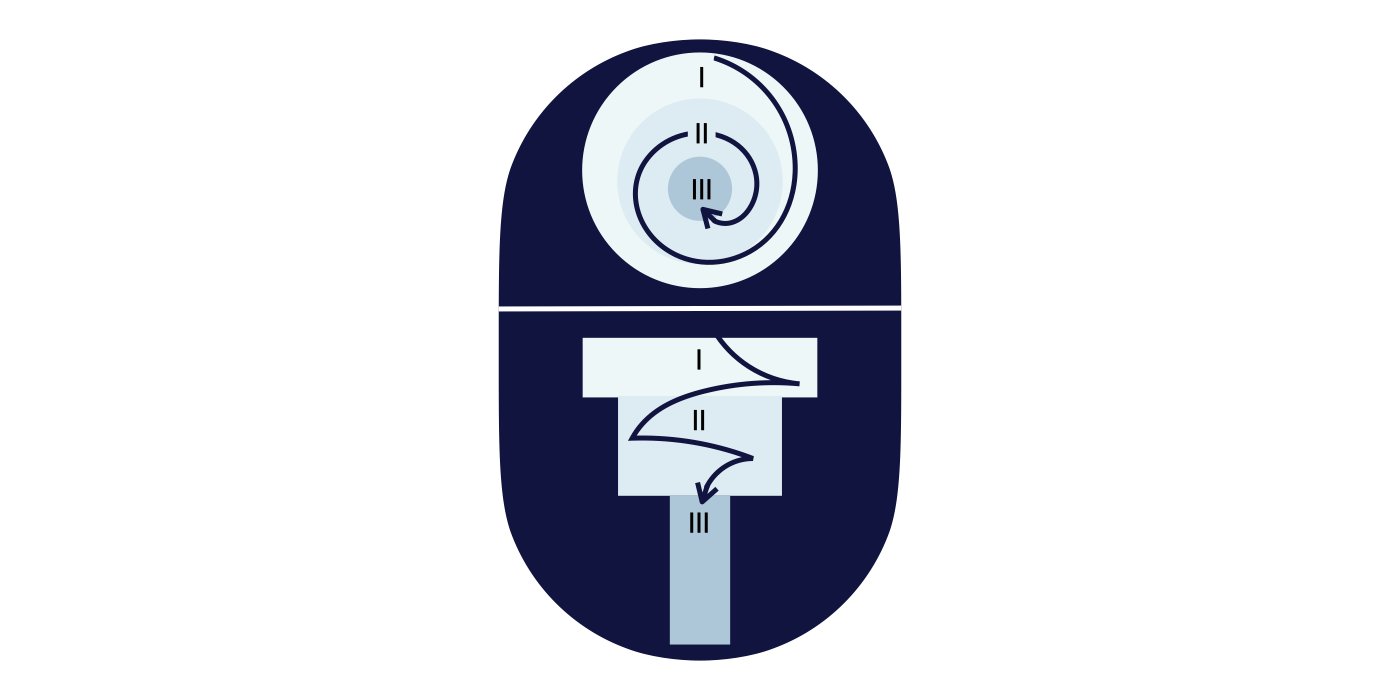
(I) - First, find free information. (II) - Then you can purchase information that experienced people have previously collected and analyzed. (III) - And only then, when the range of questions has narrowed significantly, you can directly address the subject of your desires. You can see in the picture that at each stage you delve deeper into the topic. But if at some stage you realize that you are moving in the wrong direction, you can change the scope of your search. You cannot afford to immediately delve somewhere deep without understanding whether there is something there that you need... My "Fountain of Knowledge" helps a lot in research. I will refer to it repeatedly in the text. I immediately realized that I could write my book according to this principle.
— The book has three levels of detail
I thought the idea of a book that you can delve into step by step was a very good one. It seems that no regular book is capable of this. Even in e-book format. While a web-book is capable of this. You can divide the book into several levels and assign different access rights to each level. Which is what I did. I decided to publish a public version of the book, available without registering on the site. You can read the first level of the book without any problems. While registration will provide access to the sections and chapters of deeper levels. More information about it is on the page of this section "ACCESS AND PRICES". From the outside, it will look like maps with different levels of detail. The book has three levels of detail.
First level

Second level

Third level

At each level of the book, more material is published. This is conventionally shown in three images. When I was in the military, I saw secret maps that were significantly different from a highway atlas. I think you understand what I'm talking about. An atlas allows you to get to your destination. Atlas-level maps are now used in navigation devices. Secret military maps allow you to conduct complex and risky operations. You can always choose a map that will be useful to you for what you are going to do. You can start reading the book right away without registering. I hope that even in an abbreviated form it will be useful to you. Later you can decide whether you should delve into it. This may be relevant when planning a new business, scaling an existing one, or entering foreign markets.
Illustrated book
I wrote not a simple book, but an illustrated one. It has over a thousand images that I created for you. Images are an integral part of the book. They not only illustrate and explain what I write, but also help the reader understand it faster and remember it better. The book is not a comic in the literal sense of the word, but also not an ordinary textbook with images where necessary. It stands somewhere in the middle. It is more like the picture books that we read as children. Each part of the book, each of its sections and each chapter begins with an image. These images reveal the topic, create context, and even move the reader in space. And although my readers are already adults, they are overloaded with work and are constantly distracted by important matters. I wanted them to be able to easily navigate and quickly return to reading. They could easily find the material they need after reading the book. It's hard for me to even calculate what took me longer: writing the text or creating the illustrations, and which came first. I can only say that one helped create and inspired the other. I labeled the book on the cover as "Illustrated Webbook."
Acknowledgements
I would like to express my gratitude to the people without whom this book would not have been written. To Volodymyr Shumilin, with whom I have long-standing business and personal relationships. He is a businessman. Leadership is in his DNA, and he lives to work, not vice versa. Thanks to the fact that he involved me in many international projects, I gained significant experience, which I share with you in the book. He was the first reader of my book, and thanks to his advice, it was significantly improved. To Vlad Zvarych, an infinitely talented person who is able to create amazing projects literally out of thin air. He helped me work with my clients and taught me a lot. To Andriy Rozumovich, who created a big business where there were no big opportunities. He is a role model for Ukrainian entrepreneurship. I promote his approaches to business and relationships with partners in the book. To the entrepreneurs I have consulted and discussed many aspects of their business with, but whom I cannot list here, because there are about a hundred of them. To Pavlo ***, a philologist by profession, who helped me with organizing the creative process, editing and finalizing the text. To my daughter Aya, who is now far from me. Many years ago she gave me a model of a sailboat, which inspired me to use the nautical metaphor in this book. A personal thank you to my wife Hanna, who helped with information gathering and interviews, co-authored several chapters and, in fact, financed the publication of this book. She believed in me, and that was inspiring.
Here in the preface, I will tell you what kind of reviews of my book you should look for in order to make a decision to read it. It is something like this: “This book saved my money by changing my thoughts ... ”. Or something like this: “This book confirmed my thoughts - I am starting to act ....” I hope that one of the very busy entrepreneurs will still write something like this. This would prove that I have coped with my task.