

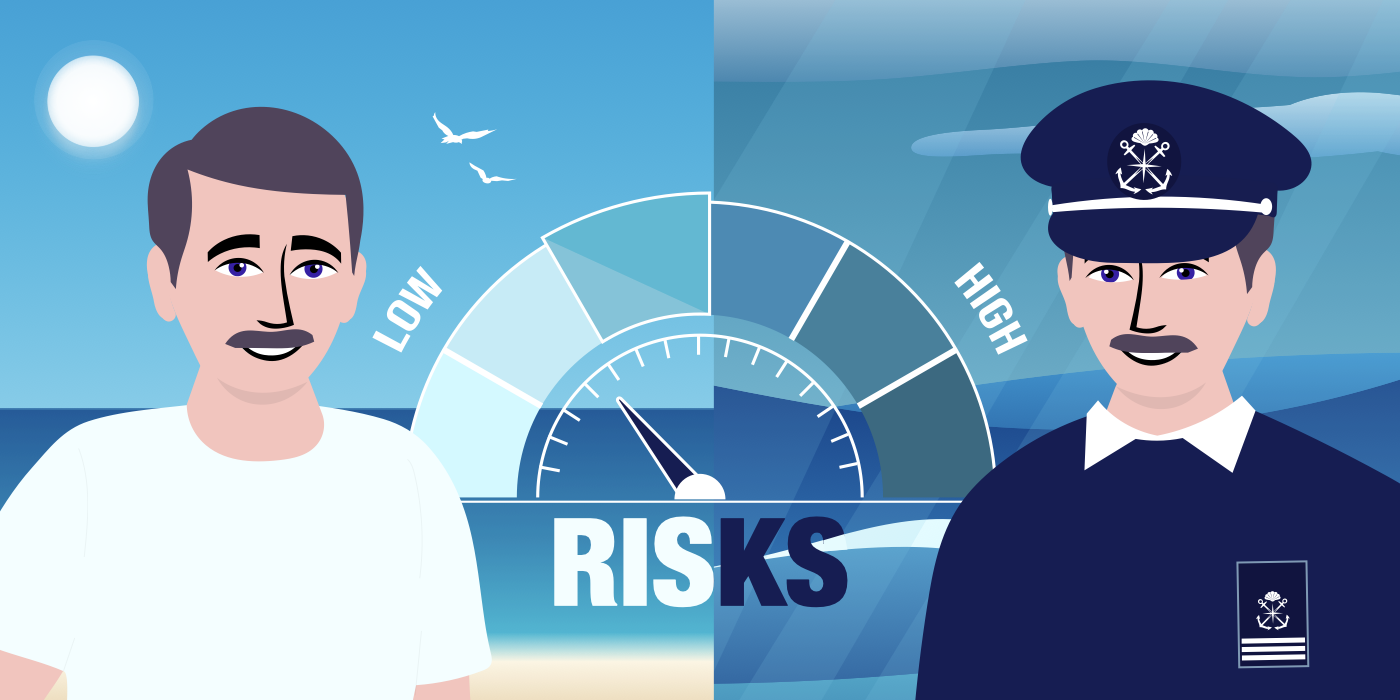
The difference between everyday life and business
Analyzing life mistakes is something we think we can do and do in everyday life. At least we know who to turn to for help in figuring it out. But business is not your personal life, and your life experience will not help you. You will find out why later. But I will still make a spoiler. Life is mostly a land-based activity, while business is similar to a sea-based one. Not only because I am using a sea metaphor here, but also because business risks are closer to sea-based than to land-based.
Life is a land-based activity

While business is like a sea
Look at the island or so-called maritime countries. They are significantly different from the land-based ones. Switzerland is not included. Moreover, the risks of mountaineering sometimes exceed those of seafaring. What exactly is the difference between water and land? It seems to me to be in three main things. There may be more, but these three, which I will mention, seem to me to be decisive. The first difference is the different transport possibilities, which have led to economic advantages. Let's leave Great Britain and Japan out of consideration, because everyone knows about them. Look at the map of Germany, which has the most extensive network of navigable rivers in Europe. And perhaps in the world. Look at the Dutch canals and Venice. Look at the large land-based countries of Central Asia. They are inhabited by intelligent, hardworking people, but it was difficult for them to reach the rest of the world. And it was even difficult to trade internally before the advent of the railway. There was a Silk Road, but there was not the volume of trade that Britain and Holland had.
The second difference is the attitude towards people. On the water, the fate of everyone can depend on the actions of one person. Because of this, in aquatic societies, respect for the individual is always greater than in land-based ones. On land, it seems that little depends on the individual.
The third difference is the higher level of risks at sea, which encourages the maritime industry to make better decisions. The descendants of the halturniks in land-based countries are still alive and employed, while in countries related to shipping, many of them drowned without having descendants. Water is not lenient with such people. I am not implying here that some have a higher level of intelligence than others. The level of intelligence is irrelevant here. At the highest level of intelligence, a person, a community, or even an entire nation that has such an advantage can lose to those who do not. This is possible precisely because it is necessary not only to have intelligence, but also to use it.
Using intelligence is controlling consequences.
What is the indicator of the use of intelligence? This, in my opinion, is the degree of control over the consequences of action or inaction. Awareness of the possible outcomes of a choice. Usually, the lower the fatality of the consequences, the lower the self-discipline, motivation, and use of intelligence to make decisions. Such decisions are made based on previously formed stereotypes or emotional background. If you feel safe, you will learn. But in business, people are constantly in dangerous situations, just like at sea. You may not notice it, doing seemingly routine things or even enjoying what you do, but danger will always be with you.
Don't wait for your own mistakes - learn from others.
If we are talking about fatal consequences - how to find out about them if they are still alive? How to prevent what is still unknown? I will have a very simple answer to this. Do not wait for your mistakes - learn from others. Before you start assessing your shortcomings, look at others. Understand which of them are the most dangerous, what their manifestations are, and why they arise.
It seems that most people do not behave this way with their health. They do not study various diseases and their manifestations in advance. Although they watch various medical series, they do not even realize that what is happening there may await them. Although it will be so - we, with very rare exceptions, will all die from diseases. Few people die in this world from old age. It is not likely that people do not know about death. They know about it, but do not perceive it properly. Apparently, this is a God-given protective reaction that helps to be happy. Moreover, I think that even some atheists do not lose hope in the immortality of the soul. They tell themselves that they are unlikely to be wrong about the fact that there is no God, but if there is, then it will not be so bad. Most atheists I have known, perhaps, have behaved quite decently in their lives. Business, in my opinion, is not like human life. At least not like peaceful life. It is more like a ship sailing at sea. The risks of a ship are much greater than the risks of everyday life. And the only reason we do not read about constant tragedies at sea is that people have learned to fight for the survival of ships and come to the aid of those who are drowning. The Titanic did not take all the lives with it, because humanity had already invented Morse code and wireless communication. Unfortunately, only a third survived, although this is a huge success. But imagine that before this invention of mankind, some ships went to sea and simply disappeared. On the shore, they didn’t even know what happened. They waited for years for the return of those who were no longer there. And so it went on for thousands of years. We can say that for almost the entire history of mankind, sea travel did not look as romantic as it is shown to us in the movies now. A hundred or so years ago, people could not even imagine that one day cruise ships would appear and old people would sell their homes and live out their days on them in complete comfort and peace. Now business reminds me of a world in which there is already wireless communication with the shore, because people die very rarely in business disasters, although business ships sink much more often than real ships. Much, much more often. It seems that this is because regulatory authorities do not require mandatory safety certification from businesses as from real ships. An unreliable business vessel can freely leave the port, while real ships that violate safety regulations will not be allowed to leave the port. But I clearly see that I can help business vessels not only not to go astray, but also to survive. This chapter is not designed to teach you how to sell more and earn more. This chapter is about survival. About the safety and salvation of your business vessel.