


After the ship has sunk, everyone knows how it could have been saved.
Some mistakes have fatal consequences, so don't wait for your own - learn from other people's mistakes.
Why is it important to analyze errors?
Why is it important to analyze mistakes? Because everyone does it? No. If only it were so. Because it allows you to avoid mistakes. No. Nothing will allow you to avoid mistakes. You will always make them, and that is normal. Then why do we analyze mistakes? Because it gives us a chance not to repeat them. A fool is someone who keeps doing the same thing, but expects a different result every time. Analyzing mistakes and preventing them means not behaving like a fool. This is not only extremely important for an entrepreneur, but also profitable.
We're talking about the unpleasant here.
Success stories will be in the next part about strategies. Here we will talk about the unpleasant. First about failures. You need to analyze your own mistakes so as not to repeat them again, and others' mistakes so as not to do them at all. The Japanese wisdom - "After the ship sank, everyone knows how to save it" - seems to me an exaggeration. I would put it a little differently - "After the ship sank, everyone should know how to save it." Then this saying turns into advice. All I can do is join this advice, and you - strictly follow it so that your business does not die prematurely. Prematurely, because natural death is always inevitable.
There are no immortal businesses - there are long-lived businesses.
The death of a business seems to be as natural and inevitable as the death of a living being. If businesses did not die, new ones could not be created in their place, so development would stop. There are no immortal businesses - there are long-lived businesses. Most often, businesses die before the age of 5, mainly due to congenital defects. A healthy business usually dies a natural death along with the departure of its founding fathers. Sometimes a business is inherited, and this prolongs its life, but, as in monarchies, the heirs do not always become worthy replacements for their great ancestors, and sometimes they do not want to rule their business empires at all. It is clear that for some time a business can work by inertia, until the grand strategy laid down by the founder of the business is exhausted. Up to a certain time, trustees can manage the business, but this invariably leads to its aging and death. The best thing you can do with a business after the founders leave is to sell it to someone worthy. A business cannot survive without a businessman or businesswoman. Being a business owner is not enough. You have to do business. If not manage it quickly, then definitely rule it. AI gave me these statistics.

About 30% of family businesses successfully pass to the second generation of heirs. Only 10-12% of such companies survive to the third generation, and only about 3% work in the fourth generation. In economics, this phenomenon is often described as the rule: "from shirts to shirts in three generations." Of course, family conflicts can play a big role here, but I think the main thing is the loss of entrepreneurial spirit. The next generations, raised in comfort, often do not have the same motivation and vision as the founder.
Ukraine is approaching the moment of change of the business generation of the "nineties".
Ukraine is approaching a critical moment when the business generation of the "nineties" must change. The change is not of the next heirs, but of the founding fathers of many national businesses. The problem is significantly complicated by the fact that the country has almost no institutions of public companies. It is not that most founders do not prepare successors in advance. The fact is that humanity has not yet come up with a better way to transfer a business as an inheritance than creating a public corporation and giving the heirs a share of its shares.
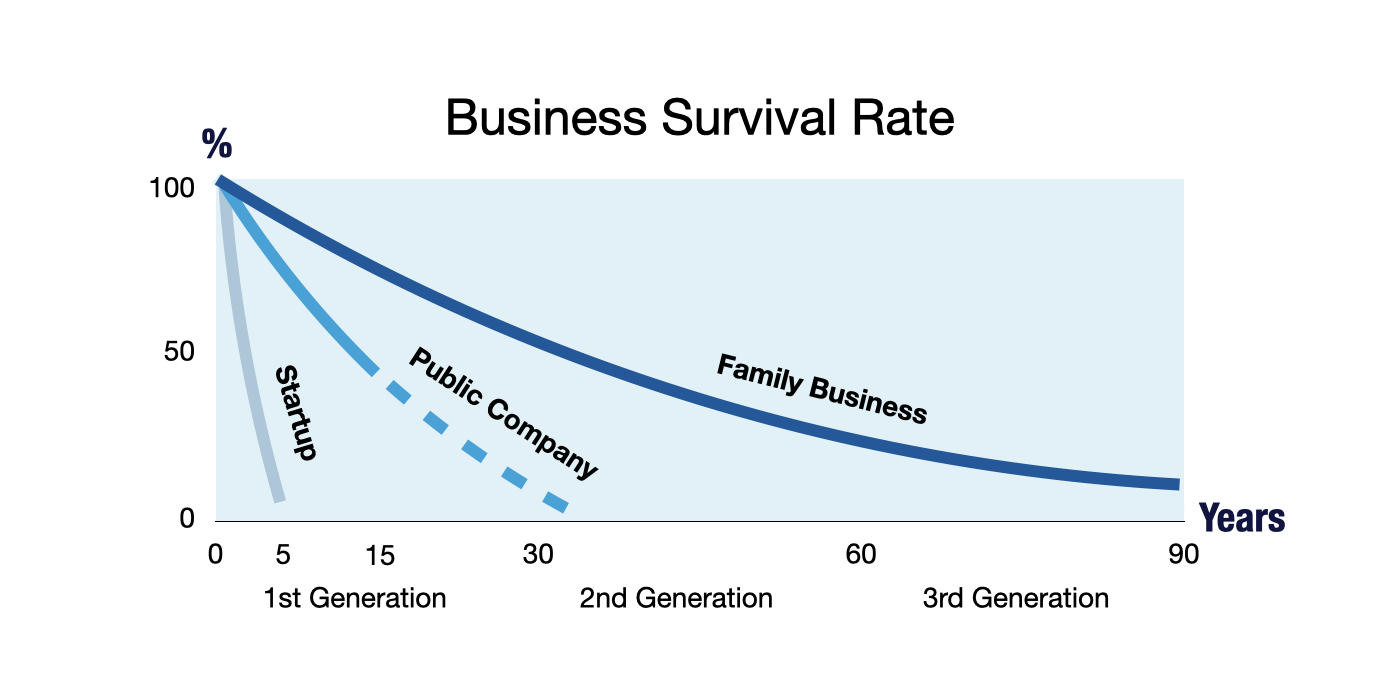
Of course, a public corporation is a somewhat socialist form of doing business. It's not that there are no owners - they seem to be there. In the form of shareholders. But shareholders are not very effective owners. That's why public companies don't live long. Remember the following recipe: "For a cow to eat less and give more milk, you need to feed it less and milk it more." Shareholders do this to some extent with public companies. Why should a stock exchange shareholder think about the longevity of a company when he can exit it at any moment by selling his shares? That's why we see on the graph that they live an average of 30 years. This is the "average temperature in the ward," but there are those that live almost forever. But most public companies are quickly exhausted by shareholders. Many public companies are now returning to private ownership. They are bought out by private investment funds. Of course, they manage them. The most famous fund is Berkshire Hathaway, created by Warren Buffett. At the time of writing, Mr. Buffett is, thank God, still alive. He is now 95 years old and still the head of Berkshire Hathaway Inc., which ranks 5th on the Fortune 500 and 9th on the Fortune Global 500. In August 2024, Berkshire Hathaway became the eighth largest company in the United States and the first non-tech company valued at more than $1 trillion. The question of how the founder will pass it on to his heirs is not a question, because Berkshire Hathaway is a public company that manages private investments. Here is such a somersault.
They didn't start their business in the nineties so that their children would be poor.
As for the ability of most founders to prepare successors in advance, I will say that they did not start their business in the nineties so that their children would be poor. Therefore, draw your own conclusions. In the nineties, I was in a business partnership with a person of royal blood from one of the European monarchies. She was a very young girl who opened a small business in the former USSR with her own money. Before that, she did something similar in Brazil. In short, she traveled the world after graduating from a prestigious university. I could not even imagine who she really was then. She was a full-fledged "Pippi Longstocking". Very modest and bargained for every penny. I later learned who she was from my brother. When her small business went bankrupt, she got a job in a tiny representative office of a famous European company. She even headed it and was the only employee there at first. Later, she hired my brother to work. As a driver. Together they achieved considerable success. The representative office grew. A truck also appeared. She delivered branded equipment and advertising materials to bars. The brave girl fell in love with the truck driver, and he with her. She invited him to Europe for Christmas. Everything was being worked out in her parents' palace. When they returned after the holidays, the guy quit. The princess begged him not to leave her, but he left. Both suffered greatly. The representative office was later closed. Khdopets turned out to be a real man, worthy of the princess's love. He was probably smarter than the girl, although he only had a secondary Soviet education. He did not want to ruin the princess's future. This is a sad story of "Anti-Cinderella". With the difference that it was not a fairy tale. But this part of the book is just for such stories. We can draw two conclusions. First, you should not fall in love at work, because this has caused many businesses to fail. Of course, there is nothing wrong with love itself, if it is always happy. But unhappy love within a company is a real business killer. Secondly, it is unlikely that the entrepreneurs of the nineties are as experienced in raising their offspring as European royal families. It is unlikely that their children will be able to fight off local bandits with royal dignity without any help from their parents, as the little girl did. As far as I know, this has happened.
Numerous misfortunes and troubles constantly threaten business.
Unfortunately, we can talk about numerous misfortunes and troubles that threaten businesses throughout their lives. Most of these threats are the same ones that threaten people's lives. Natural disasters, fires, wars, robberies, epidemics, etc. Society is ready to help businesses overcome the consequences of troubles caused by such events. But there is a special threat in business. All threats have a threat. This is competition. Society will not help you protect your business from this threat. It is safe to say that competition will be the second main cause of premature death of a business after its infant mortality.